Norwood Scale Explained: Stages and Graft Estimates
What Is the Norwood Scale? The Short Answer
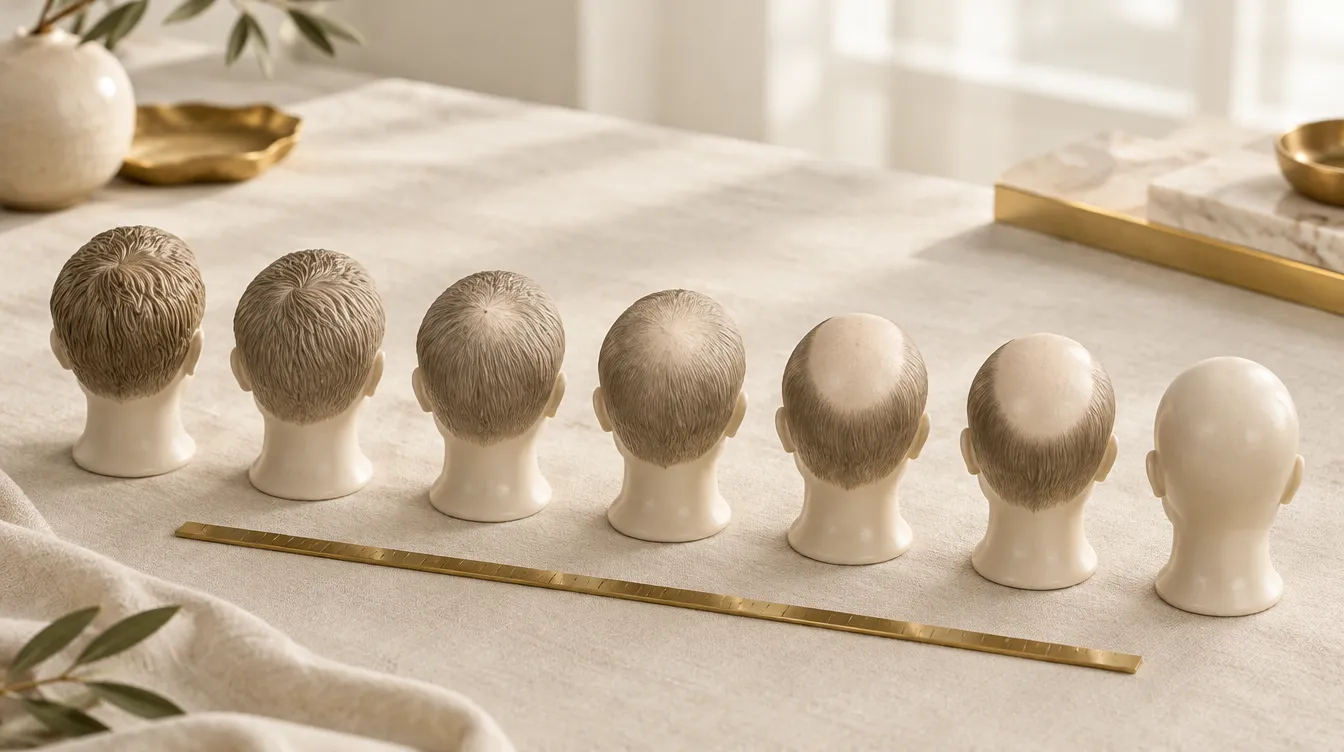
The Norwood scale is a 7-stage chart that surgeons use to grade male pattern hair loss, from stage 1 (no real recession) to stage 7 (only a band of hair left at the back and sides). Each stage gives a rough guide to how many grafts you might need, from around 800 for an early receding hairline to 5,000 or more over a lifetime for the most advanced loss.
It is a useful starting point, but it is only a starting point. Two men at the same stage can need very different plans, because the scale doesn't measure donor density, hair thickness or how fast your hair loss is moving. This guide explains each stage, gives published graft ranges for each one and shows where the scale falls short.
Where the Norwood Scale Comes From
From Hamilton to Norwood
The scale builds on earlier work by Hamilton, who sorted hair loss patterns from observations of more than 700 people. In 1975, Dr O'Tar Norwood refined it in his paper Male pattern baldness: classification and incidence, published in the Southern Medical Journal. That is why you will see it called the Norwood scale or the Hamilton-Norwood scale.
A March 2026 paper in Frontiers in Medicine points out that Norwood based his patterns on "the study of over 1,000 Caucasian men". That matters, and we come back to it below.
Why surgeons still use it
It is quick. A surgeon can look at a photo and give a stage in seconds, with no special equipment. The same 2026 paper lists simplicity and accessibility as its main strengths. It gives you and your surgeon a shared language for where you are now and where you might end up.
The 7 Norwood Stages, With Graft Estimates
The table below shows each stage and two graft ranges. The first is a typical first session. The second is the total you might need over one or more sessions for a full restoration. These figures are planning ranges published by Bernstein Medical, a hair restoration centre in New York. They are not a quote for your scalp.
| Norwood stage | What it looks like | First session (grafts) | Total over time (grafts) | |---|---|---|---| | 1 | No real recession. Adult hairline intact | Not usually treated | Not usually treated | | 2 (2a) | Slight recession at the temples | 800 to 1,400 | 1,400 to 2,200 | | 3 | Clear M-shape at the temples | 1,000 to 1,600 | 1,600 to 2,400 | | 3 Vertex | Stage 3 hairline plus thinning at the crown | 1,200 to 1,600 | 1,800 to 2,600 | | 4 | Deeper frontal loss and a bald patch at the crown | 1,600 to 2,200 | 2,200 to 3,400 | | 5 | Front and crown loss, with a thinning bridge between them | 2,000 to 2,500 | 2,600 to 3,800 | | 6 | The bridge has gone. Front and crown join up | 2,400 to 3,000 | 3,000 to 4,600 | | 7 | Only a band of hair at the back and sides | 2,500 to 3,200 | 3,200 to 5,000 |
Source: Bernstein Medical graft number guide. Ranges for the hairline and front of the scalp. Bernstein gives higher ranges where the crown is also treated, for example 2,200 to 2,600 grafts in a first session at stage 4.
Stages 2 and 3: the receding hairline
This is where most men first notice something. The temples move back and the hairline forms an M. Stage 2 is often still within the normal range of a mature male hairline. Stage 3 is usually the point where hair loss is clear to other people. Our guide to a receding hairline covers the causes in more detail.
Stages 4 and 5: front and crown
At stage 4, the front has receded further and a bald patch has formed at the crown. At stage 5, the band of hair between them is thinning. This is where planning gets harder. There is more ground to cover than one session can usually fill, so the surgeon has to decide what to treat first.
Stages 6 and 7: advanced loss
At stage 6 and 7, the whole top of the scalp is bald or close to it. The limit here is your donor area. Bernstein's commentary says the goal should be the best possible result "in the context of the patient's total donor reserves". In plain terms, there may not be enough donor hair to cover everything, so the plan usually focuses on framing the face.
The "A" variants
Some men lose hair from front to back in a straight line, without the M-shape or a crown patch. These are labelled 2a, 3a, 4a and 5a. Bernstein's ranges for these are slightly higher, for example 1,400 to 1,800 grafts in a first session at stage 3a, because the front of the scalp takes more grafts to look full.
Why Two Men at the Same Stage Need Different Grafts
The stage tells you the shape of your hair loss. It doesn't tell you how much hair you have to work with. These factors change the number:
- Donor density. More follicular units per square centimetre at the back means more grafts can be taken safely.
- Hair thickness. Coarse hair covers more scalp per graft than fine hair.
- Colour contrast. Dark hair on pale skin shows gaps more than hair closer to your skin tone.
- Curl. Wavy and curly hair gives more coverage per graft.
- Age and family history. A 26-year-old at stage 3 may be heading for stage 6. A 50-year-old at stage 3 may stay there.
- What you want. A soft, mature hairline needs fewer grafts than a low, dense one.
Our guide on donor area limits explains how density and hair thickness decide your lifetime graft supply.
Where the Norwood Scale Falls Short
It is subjective
Grading is done by eye, so different doctors can give the same man different stages. A 2025 study in Scientific Reports cites "65–78% reproducibility for Norwood–Hamilton staging". The authors also found that the middle grades, especially stages 3 and 5, were the hardest to tell apart, even with their computer-based method. The 2026 Frontiers paper notes lower agreement for Norwood than for the newer Basic and Specific system.
It misses some patterns
The scale was built from one group of men, and some common patterns don't fit. The 2026 Frontiers paper says "isolated vertex thinning and ethnic variation often fall outside their structure". It also says these scales "primarily describe surface-level patterns". They don't show follicle density or early miniaturisation, where hairs get thinner before they fall out.
It doesn't show your future
The scale is a snapshot. Male pattern hair loss is permanent and usually keeps going. The NHS says it "usually runs in the family" and that finasteride and minoxidil are the main treatments, adding that "no treatment is 100% effective". Whether medication is right for you is something to discuss with a doctor or prescriber. A good plan places grafts where they will still look natural if your loss moves on by a stage or two. Our post on the best age for a hair transplant covers why this matters most for younger men.
How to Use the Scale Before Your Consultation
Check your own stage
- Take photos in good light from the front, top and side, with dry hair pushed back.
- Look at your temples. Is there an M-shape, or does the whole hairline sit further back?
- Look at your crown. Is the scalp visible there?
- Compare with the table above and pick the closest stage. If you're between two, note both.
What happens next with us
Self-grading gives you a rough idea. An assessment gives you a real number. Here is how our process works:
- Send 3 photos: front, top and side.
- Get a graft estimate: we look at your stage and your donor area and give you a realistic range.
- Video call: we talk through the plan, including what to treat first and what to keep in reserve.
Procedures take place at our partner clinic in Chiswick, led by GMC-registered surgeons, with one patient a day. Sapphire FUE is from £3,299 and DHI from £3,999, one price up to 4,000 grafts, with PRP on the day and aftercare included. That covers the first-session range for every stage in the table. If you'd like to spread the cost, our 0% payment plans start with a deposit from £299 and 3 to 9 monthly payments, with no credit check, paid off before surgery.
Want a quick figure first? Try our graft calculator or see how we compare on cost per graft.
Related Reading
- How Many Grafts Do I Need for My Hair Transplant?
- Crown Hair Transplant: Restoring the Bald Spot
- Donor Area: How Many Grafts Can You Take in a Lifetime?
- FUE vs DHI: Which Method Is Right for You?
Frequently Asked Questions
What Norwood stage am I?
Compare your temples and crown with the stages above. A clear M-shape with no crown loss is usually stage 3. Front and crown loss with a band of hair between them is usually stage 5. A surgeon can confirm it from photos.
How many grafts do I need for Norwood 3?
Published planning ranges suggest about 1,000 to 1,600 grafts for a first session at stage 3, and 1,600 to 2,400 in total over time. Your donor area and hair type will move that number up or down.
How many grafts do I need for Norwood 5?
Around 2,000 to 2,500 grafts for the front in a first session, rising to 2,500 to 2,800 if the crown is treated too, based on Bernstein Medical's ranges. Most men at stage 5 need to prioritise the front.
Can you have a hair transplant at Norwood 6 or 7?
Often yes, but full coverage is rarely possible. The donor area limits how many grafts can be moved, so the plan usually focuses on the hairline and front to frame the face.
Is Norwood 2 normal?
Slight temple recession is common as men mature and doesn't always mean ongoing hair loss. If it is moving quickly or runs in your family, it is worth getting assessed early.
Is the Norwood scale accurate?
It is a useful guide but subjective. A 2025 study cites 65% to 78% reproducibility between assessors. It also doesn't measure density or hair thickness, which is why a proper assessment matters.
Not sure where you sit on the Norwood scale? Send us 3 photos and get a realistic graft estimate from our team. Book a free consultation.
Ready to Start Your Hair Restoration Journey?
Book a consultation to discuss your goals and receive a personalised treatment plan
Book Consultation